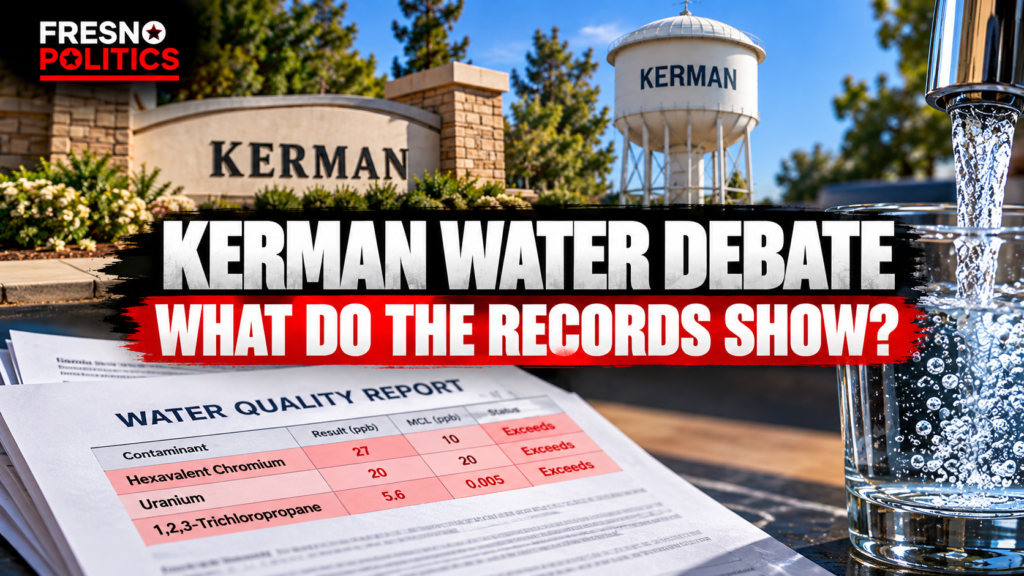
The Fresno County District 1 supervisor race turned into a debate over drinking water Monday night, with candidates Mike Karbassi and Maria Pacheco offering sharply different descriptions of Kerman’s water quality.
The disagreement came during a Sept. 28 candidate forum in northwest Fresno hosted by Highway City Community Development.
Karbassi, a Fresno City Council member, held up Kerman water reports and argued that the city’s drinking water has contamination issues.
Pacheco, the mayor of Kerman, pushed back, saying Kerman’s water is safe to drink.
But what do the official records show?
Kerman does have documented water-quality exceedances
This is where the debate requires some context.
The City of Kerman itself has published drinking-water notices documenting levels of certain contaminants above California drinking-water standards. Its drinking-water notice page currently lists 2026 notices for 1,2,3-trichloropropane, uranium and hexavalent chromium.
Kerman also issued a public notice regarding hexavalent chromium.
According to the city’s notice, water samples collected between March and October 2025 showed running annual average hexavalent chromium concentrations ranging from 0.016 to 0.027 milligrams per liter at several wells.
California’s maximum contaminant level for hexavalent chromium is 0.010 milligrams per liter, or 10 parts per billion.
The city’s notice says residents do not need to use an alternative water supply and that the situation is not an emergency. At the same time, it warns that people who drink water containing hexavalent chromium above the MCL over many years may face an increased cancer risk.
That distinction is important.
An exceedance of a drinking-water standard does not automatically mean residents are facing an immediate emergency.
What about uranium and 1,2,3-TCP?
Kerman’s official drinking-water records also document concerns involving uranium and 1,2,3-trichloropropane, commonly called 1,2,3-TCP.
The city’s public notice page specifically identifies quarterly reports for those contaminants and says the reports concern levels above drinking-water standards.
A California environmental review for Kerman’s hexavalent chromium compliance project also states that the city’s groundwater has contained 1,2,3-trichloropropane, arsenic, uranium and hexavalent chromium at concentrations exceeding maximum contaminant levels, and that Kerman has outstanding compliance orders involving uranium and TCP.
Kerman relies on groundwater for its drinking-water supply, according to the California environmental review.
So was Karbassi right?
Karbassi said during the forum that “the water in Kerman isn’t clean.”
There is documented evidence that Kerman’s water system has had contaminant concentrations above applicable drinking-water standards.
However, describing the entire municipal water supply simply as “not clean” leaves out an important part of the picture.
The City of Kerman’s own notice says the hexavalent chromium exceedance does not require residents to switch to bottled water and is not considered an emergency. The city is working with state regulators on compliance.
So the underlying concern about contamination is supported by official records, but the broader characterization of Kerman’s water requires context.
What about Pacheco’s claim that Kerman’s water is safe?
Pacheco told The Fresno Bee that “Kerman’s water is safe” and said she continues to drink tap water in the city.
That statement also needs context.
Kerman’s own public notice does not say that the city’s water has no contamination concerns. Instead, it acknowledges hexavalent chromium levels above the state standard while explaining that the situation is not an emergency and that the city is working toward compliance.
California’s State Water Resources Control Board confirms that the hexavalent chromium standard is 10 micrograms per liter and establishes compliance timelines for water systems depending on their size.
In other words, “safe” and “above the drinking-water standard” are being used to describe different aspects of the issue.
The official records support a more nuanced description than either campaign-style sound bite alone.
Why the water debate matters in the supervisor race
Water infrastructure is particularly important in Fresno County, where many communities depend heavily on groundwater.
For voters in the western portion of the county, the disagreement raises a broader question about what the next supervisor should do about water systems that face contamination or infrastructure challenges.
The issue also highlights the difference between identifying a water-quality violation and determining what action is necessary to correct it.
Kerman says it is working with state regulators on a compliance plan for hexavalent chromium.
The debate went beyond water
The Sept. 28 forum also included disagreements over development, campaign contributions and the proposed Southeast Development Area, or SEDA.
Karbassi said he expects a SEDA vote later this year and argued that the proposal does not make financial sense. Pacheco questioned Karbassi’s campaign contributions from developers and contractors, while Karbassi responded by pointing to Pacheco’s own contributions and political connections.
Those claims involve separate questions that should be evaluated against campaign-finance records and the candidates’ stated positions rather than forum rhetoric.
The forum also featured District 1 Fresno City Council candidate Naindeep Singh, while his opponent Rob Fuentes did not attend. The Fresno Bee reported that Fuentes said he teaches a Monday-night class at San Joaquin College of Law and had asked organizers to reschedule the event.
Singh again expressed opposition to SEDA and criticized Fresno Mayor Jerry Dyer’s spending, saying the city needs to be more financially prudent.
The Kerman water dispute is not simply a question of whether the city’s water is “clean” or “dirty.”
Official records show that Kerman has documented exceedances involving contaminants including hexavalent chromium, uranium and 1,2,3-trichloropropane, and the city is working through regulatory requirements to address those issues.
At the same time, Kerman’s public notice says the hexavalent chromium issue is not an emergency and does not require residents to obtain an alternative water supply.
For voters, the more useful question may be what each supervisor candidate would actually do about water quality, infrastructure funding, regulatory compliance and long-term water security.
The records show a real water-quality issue. The political debate is over how serious it is, how it should be described and what should be done about it.